Mechanisms before memorisation
Each chapter states the one or two rules that generate everything else in it. The classification in the middle is derived from those rules, so it reads as a consequence rather than an arbitrary list.
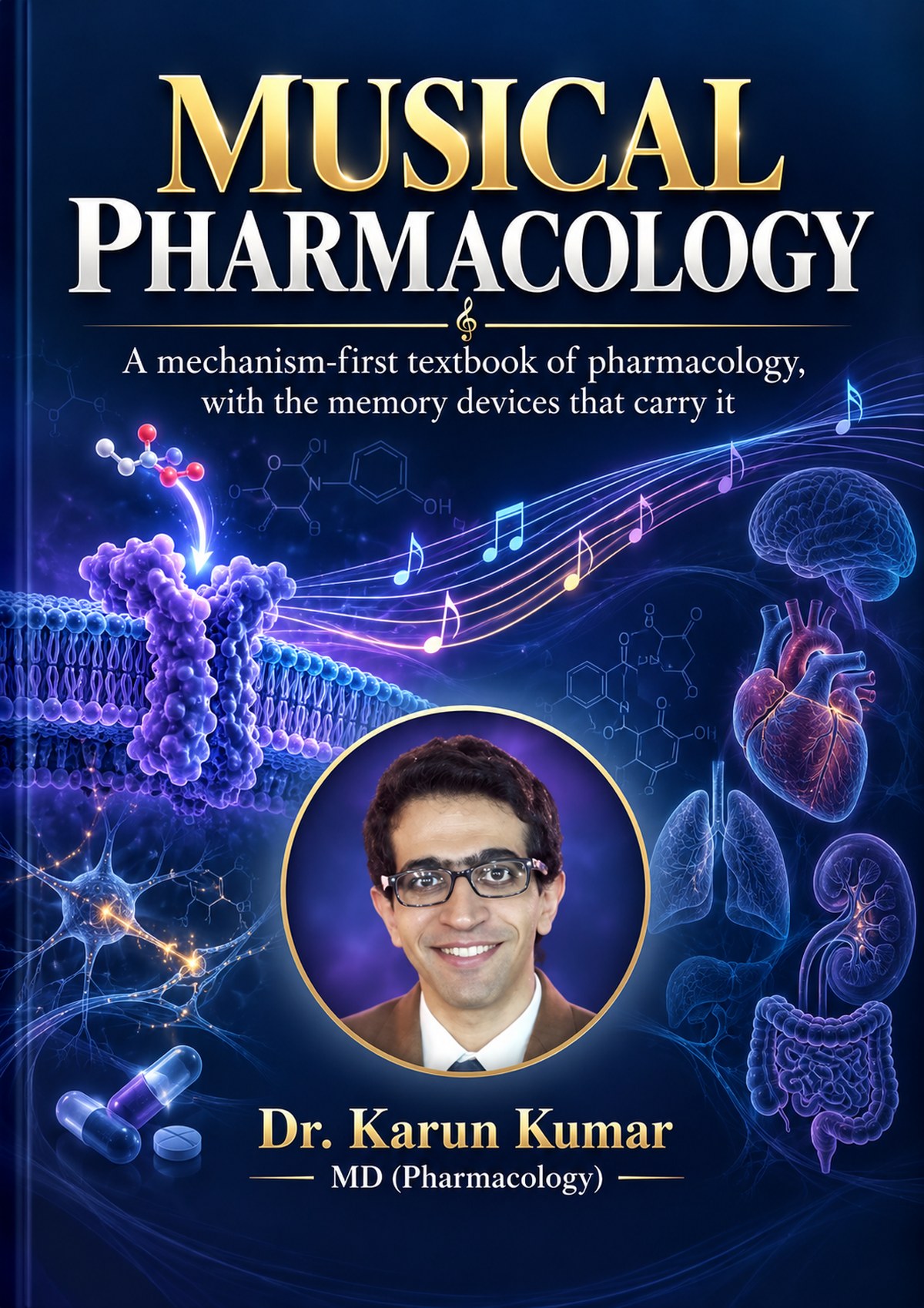
Musical Pharmacology is a digital textbook for medical students that explains each drug from what it does to a molecule to what it does to a patient, then gives you memory devices for the lists that remain.
Drug classes, receptor subtypes, adverse effects, contraindications and interactions, all learned separately and all needed at the same time in an examination.
You can state how a drug acts and, separately, what it is used for, but not how one leads to the other.
Two drugs with similar effects and different mechanisms blur together, and the distinction is exactly what gets asked.
Lists memorised for a fortnight are hard to retrieve under pressure and harder still two years later, at postgraduate entrance or on the ward.
The lists are rarely the real difficulty. Each one is the answer to a question nobody asked out loud, and without the question there is nothing to hang the answer on.
Every drug in the book is followed along the same chain. Once you can see the chain, the effects, uses and cautions of a class arrive already organised.
The receptor, enzyme, channel or transporter it acts on.
The signal changed and the response that follows.
The tissues that carry the target, and how they respond.
The therapeutic effect, and the effects nobody wanted.
A sympathetic organ shut down by a parasympathetic blocker looks like a contradiction to memorise. With the transmitter table in front of you, it follows directly.
Each chapter states the one or two rules that generate everything else in it. The classification in the middle is derived from those rules, so it reads as a consequence rather than an arbitrary list.
The musical structure came out of teaching the material aloud. It is how the content hangs together:
Letter carriers, metre and rhyme carriers, and sentence devices that state why a list exists as well as what is on it. Standard devices are marked as standard; the author's own are not passed off as anything else.
Chapters open with a clinical case and connect mechanism to therapeutic use, adverse effects and contraindications. Doses and indications are given to show how a drug's pharmacology produces them.
Comparison tables for receptors, transmitters and drug classes, and a closing passage in each chapter that gathers what a reader should carry out of it.
Written against six named reference works. Page numbers are printed only where they can be checked, and where sources disagree the disagreement is printed rather than resolved out of sight.
General principles first, then each system in turn, then the antimicrobials, the antineoplastics and the applied topics that draw on all of them.
Tap a section to see its chapters. The book also includes a preface, notes on the memory devices and chapter numbering, a Sources and Locators chapter naming the six reference works, and an index of drugs, drug stems and subjects.
The excerpts below are transcribed from the PDF, with page numbers, so you can judge the writing for yourself.
A student can pass a pharmacology examination by holding several hundred lists in mind for about a fortnight. I have watched it done, I have examined the people who did it, and I have taught the ones who came back two years later having kept none of it. The lists are not the problem. The problem is that a list is the answer to a question nobody asked out loud, and a student who never hears the question has nothing to hang the answer on.
This book is an attempt to put the questions back.
A complete pharmacology textbook in PDF form, written by Dr. Karun Kumar, MD (Pharmacology). It runs to about 1,077 pages in 80 chapters and 14 sections. Each topic is explained from the drug's mechanism through to its clinical effects, and memory devices are included to help you retrieve classifications and other lists.
MBBS students studying or revising pharmacology, medical graduates preparing for postgraduate entrance examinations, and teachers of pharmacology. It suits readers who want to understand why drugs behave as they do. Chapters are designed to be read from the beginning, because each classification is derived from the rules stated at the start.
General pharmacology (including pharmacokinetics, pharmacodynamics and adverse drug effects), the autonomic nervous system, autacoids and inflammation, respiratory drugs, hormones, neuromuscular and local anaesthetic drugs, CNS pharmacology, cardiovascular, renal, blood, gastrointestinal, antimicrobial and antineoplastic drugs, and applied topics such as immunosuppressants, toxicology, vaccines and drug interactions. The full chapter list is in the contents section above.
It is a digital product: the complete book as a single PDF file. No printed copy is posted.
When your payment is completed, the payment page takes you to the download page for the book, where you can download the PDF straight away. Save the file to your device so you can open it later.
Yes. Some memory devices are built on Hindi phrases; where they are, the English meaning is printed beside them.
Yes. It is written for study and revision, with comparison tables, memory devices, and a closing passage in each chapter that gathers what to carry away. How well it works for you depends on how you study; no particular result is promised.
No. In the author's words, it is a synthesis arranged to be understood and remembered, not a substitute for the reference works it is written against. It is not a prescribing authority: prescribers should work from current approved product information, the national formulary and the guidelines in force where they practise.
The download page has a second, direct link that opens the PDF in your browser, from where you can save it. If neither works, contact karun_kumar@live.in with your payment reference.